Editorial draft · Sample text to be approved before publication.
Editorial illustration.A THREE-AXIS PERSPECTIVE
01
Promise
What value for the audience?
02
Credibility
Why your brand?
03
Continuity
What resources can you sustain?
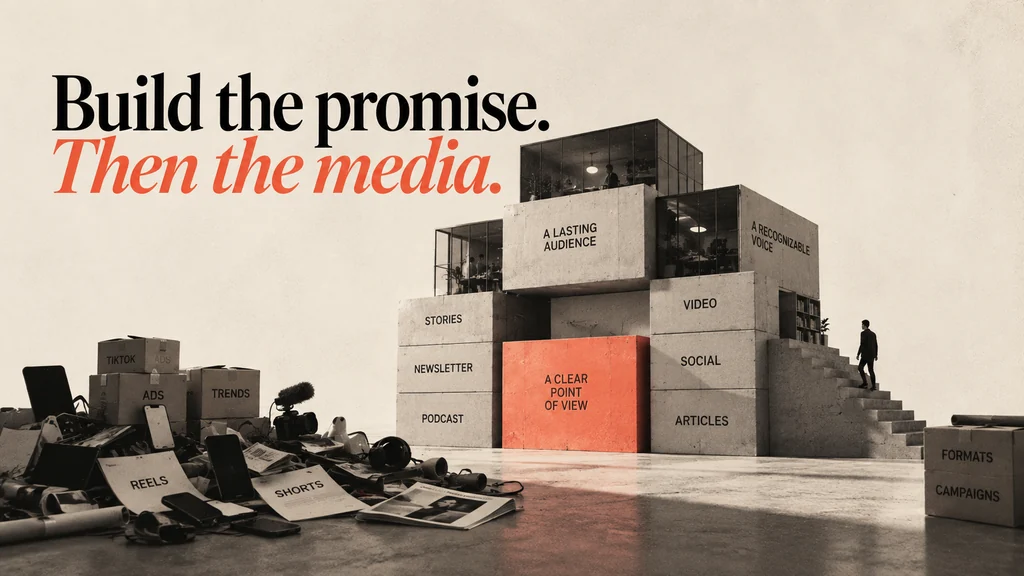
Becoming a media brand is an appealing ambition. It suggests a loyal audience, a recognisable voice and less reliance on paid advertising. But launching formats is not enough to create a publication. There needs to be a reason for it to exist from the reader’s perspective.
Start with an editorial need
A business often holds useful knowledge: recurring customer questions, lessons from the field, methods or access to particular experts. This material can support a publication. It does not require covering every development in the industry.
The strongest starting point is a specific need that the organisation can meet better or differently. Explaining a complex topic, documenting a transformation or sharing practical lessons is already a promise. A focused position can provide more coherence than an overly broad ambition.
The question is not “what can we publish?” but “what can people expect from us?”
Give editorial work the resources to last
An editorial direction involves choices and trade-offs. Who selects the topics? Who checks the facts? How much time can actually be devoted to publishing? A sustainable rhythm is better than a spectacular launch followed by months of silence.
It also means accepting that useful content will not always discuss the product directly. Relationships develop by helping readers understand their environment. This does not remove the commercial goal; it places it in a longer time frame.
Start with one promise, one format, one rhythm
A clearly defined series of analyses lets you test audience interest without immediately building a full editorial team. You can then examine feedback, topics that spark discussion and the team’s ability to sustain quality.
Becoming a media company is not a compulsory step for every brand. It is an organisational choice as much as a communications choice. It should be made for a specific reason, with appropriate resources and a promise that can be kept.
A brand publication must earn its place
Patagonia publishes stories about places, sports and environmental causes on its Stories site, beyond product listings. The material is connected to the company’s activities and access. That observation alone does not establish a sales effect: Patagonia provides no controlled comparison there that would support one.
Since 2024, YouTube has allowed creators to group products from other brands or their own lines into Shopping Collections. The same interface can support recommendation, discovery and a purchase. This does not turn every brand into a publisher. It makes the difference between serving an audience and maintaining a commercial presence more consequential.
Our thesis is that a brand should build a publication when it has original material and the capacity to sustain it. Otherwise a collaboration with a credible publisher or creator may serve it better than an owned channel with no clear promise. The promise and the organisation come before the format.
StellaR Contents Exhibit · Conceptual framework
The editorial promise comes before the channel
01
Material
Distinct access to people, topics or data.
02
Promise
Audience value even without immediate product exposure.
03
Capacity
Ownership, verification and a sustainable rhythm.
StellaR Contents analysis. Qualitative model; no numeric values.
What this changes
Before staffing a full editorial team, test a recurring subject, one format and clear ownership for a defined period. Useful questions and qualified responses can indicate whether a habit is forming; sales figures alone cannot isolate the editorial effect.
Three questions for decision-makers
Which subject gives us a distinctive and credible voice?
Would people value this work without buying immediately?
Who will protect quality and consistency after launch?
Method and limits. Patagonia illustrates an observable editorial practice, not a causal revenue result. The framework is qualitative.
Sources & reference points
All Stories — Patagonia, online publication, accessed September 2026.