

A video can reach ten million people without many of them remembering, a week later, where it came from.
By contrast, a newsletter read by a few tens of thousands can become such a fixture that its absence is noticed. If it reaches the right people, its influence may extend far beyond its direct readership.
Both have an audience. They have not built the same asset.
That is part of the ambiguity of the word. An audience can mean people exposed to a piece of content once, or people who actively seek out a brand, await its next publication and trust it enough to follow it into something new.
Platforms have radically expanded the ability of publishers, brands and creators to meet new audiences. A video, an article or a podcast can now travel far beyond the people who already know its author. They are extraordinary engines of discovery.
But the performance of a piece of content does not automatically transfer to the brand behind it. Something has to be built between the two.
Not all views mean the same thing anymore
YouTube has just provided a particularly useful illustration.
Since August 24, 2026, a public view has been counted as soon as a video begins to play, from its first frame. The definition now applies across Shorts, long-form videos, podcasts and live streams.
The previous measure has not disappeared. YouTube retains it in Analytics as Engaged views, separating exposure to a video from a decision to keep watching. The distinction matters enough that creator earnings still depend on Engaged Shorts views and Engaged Watch Hours, rather than the public view counter alone.
Views now measure exposure. Engaged views begin to measure choice.
This is more than a reporting change. It makes visible a logic already central to recommendation systems: people shown the same content do not all respond in the same way.
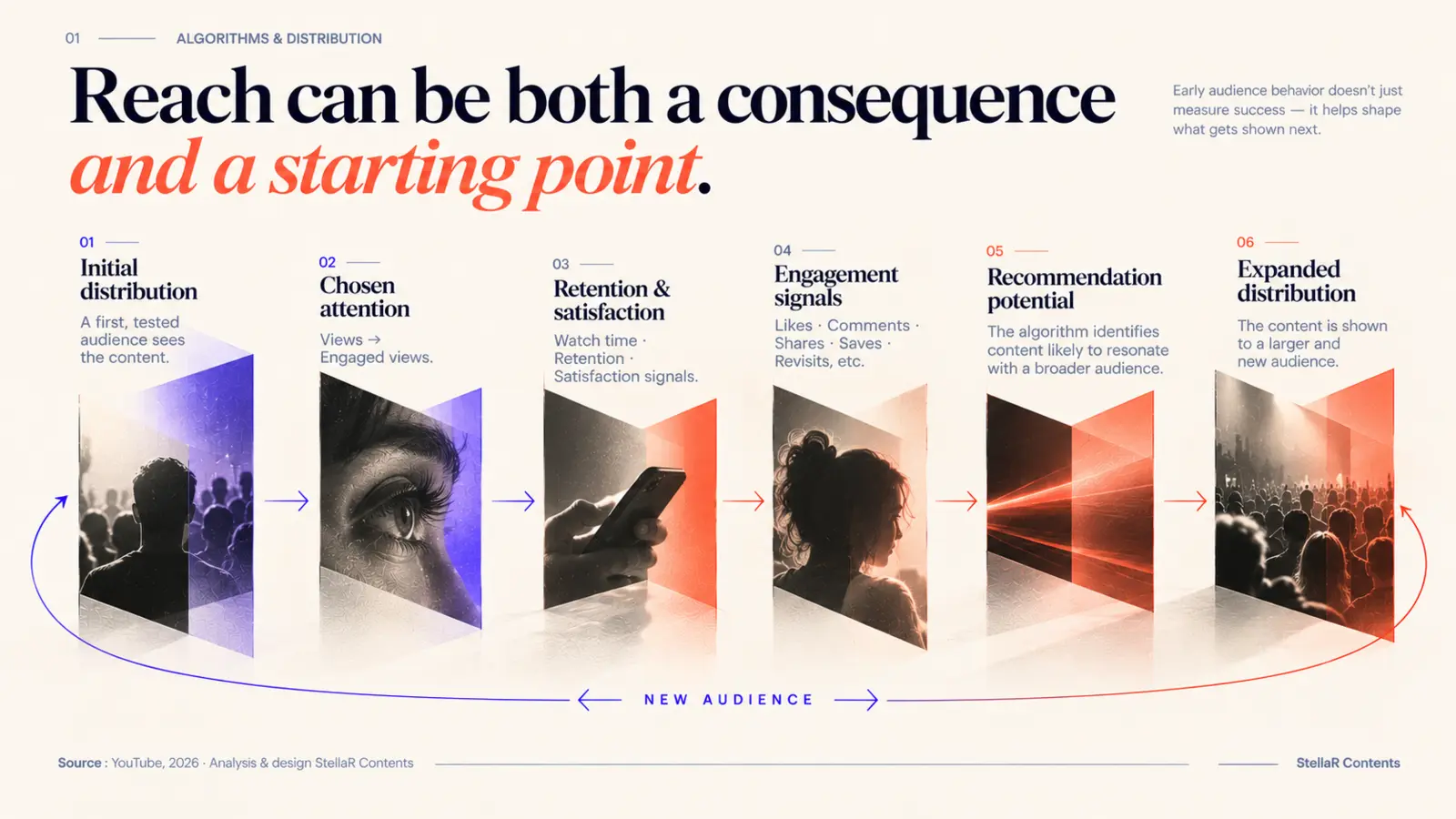
YouTube describes content performance through three broad groups of signals: appeal (does someone choose to watch?), engagement (do they stay after starting?) and satisfaction (did the experience appear worthwhile?). Watch time and percentage viewed, likes, shares, comments and satisfaction signals all play a part, alongside other information and personalization, in predicting what different users may want to watch.
Retention is therefore more than a retrospective measure of whether a video worked. It contributes to the signals used to estimate its potential relevance to other people.
Reach is no longer only a starting point for performance. It can also be a consequence. A video reaches an initial audience. Some choose to watch. When the observed signals are positive, the system has more information to estimate who else might value it. Distribution can expand.
Platforms need to know who stays
The same shift is visible at Meta.
In 2026, Facebook introduced new metrics to its monetization program, including Qualified Views, and said it wanted to reward content that produces deeper engagement and longer watch time.
Months earlier, Meta reported that time spent watching video on Facebook had risen by more than 20% year over year in the United States. Reels longer than a minute accounted for roughly one quarter of Reels published by creators with more than 10,000 followers, yet generated more than half of Facebook watch time.
Retention is therefore a particularly useful signal. Not because it proves the editorial quality or trustworthiness of a piece of content on its own. It tells the platform something more practical: did the people who were shown this content find enough value to stay?
Combined with other signals, that information helps recommendation systems decide what may be worth showing to others. The mechanism can create a reinforcing loop: interest → retention → recommendation → reach → new observations → recommendation.
For a creator or a brand, that is excellent news. Up to a point.
A piece of content can win without its brand winning as much
Imagine an exceptionally effective video. It stops the scroll. Early viewers stay. Retention is strong. The platform sees positive signals and widens distribution. Eventually, millions watch it.
For the content, this is a success. For the platform, too.
But how many viewers remember, days later, who was speaking to them? How many correctly attribute the video to the brand? How many better understand what it stands for? How many want to find it again?
This is where two interests that were initially aligned begin to diverge. The platform wants to identify the next piece of content a user will watch. The brand wants to become the source that user will seek out next.
Strong algorithmic performance can help the latter. It cannot guarantee it.
A large 2026 study by WPP Media, System1 and TikTok illustrates the point. It analyzed 1,217 paid TikTok ads, including 620 creator ads, tested with more than 182,000 users across eight markets, and linked creative performance to hundreds of brand-lift studies.
Creator content can be highly effective: on average, it produces more Brand Memory Lift than short-form content made directly by brands. But advertisers capture that value very unevenly.
Two thirds of the creator campaigns examined do not build enough brand memory. Creative quality, actual recognition of the creator and, especially, the fit between creator and brand all materially affect the outcome.
The content can be compelling without making the brand memorable. A piece of content can win the battle for attention while its brand loses the battle for memory.
Value is lost between attention and consideration
This distinction extends well beyond advertising. People can remember a fact without remembering its source. Enjoy a video without subscribing to the channel. Read an article found through Google without remembering the publication. Watch a brand’s Reel to the end without ever seeking out its account.
In each case, the content may have performed. Whether the brand gained nearly as much is a different question.
A 2025 study by WPP Media, Snapchat and Lumen sheds light on part of that difference. Very brief attention can already contribute to brand recall. Changing perception more meaningfully takes longer: in this experiment in India, brand favorability began to increase significantly when attention lasted between three and nine seconds.
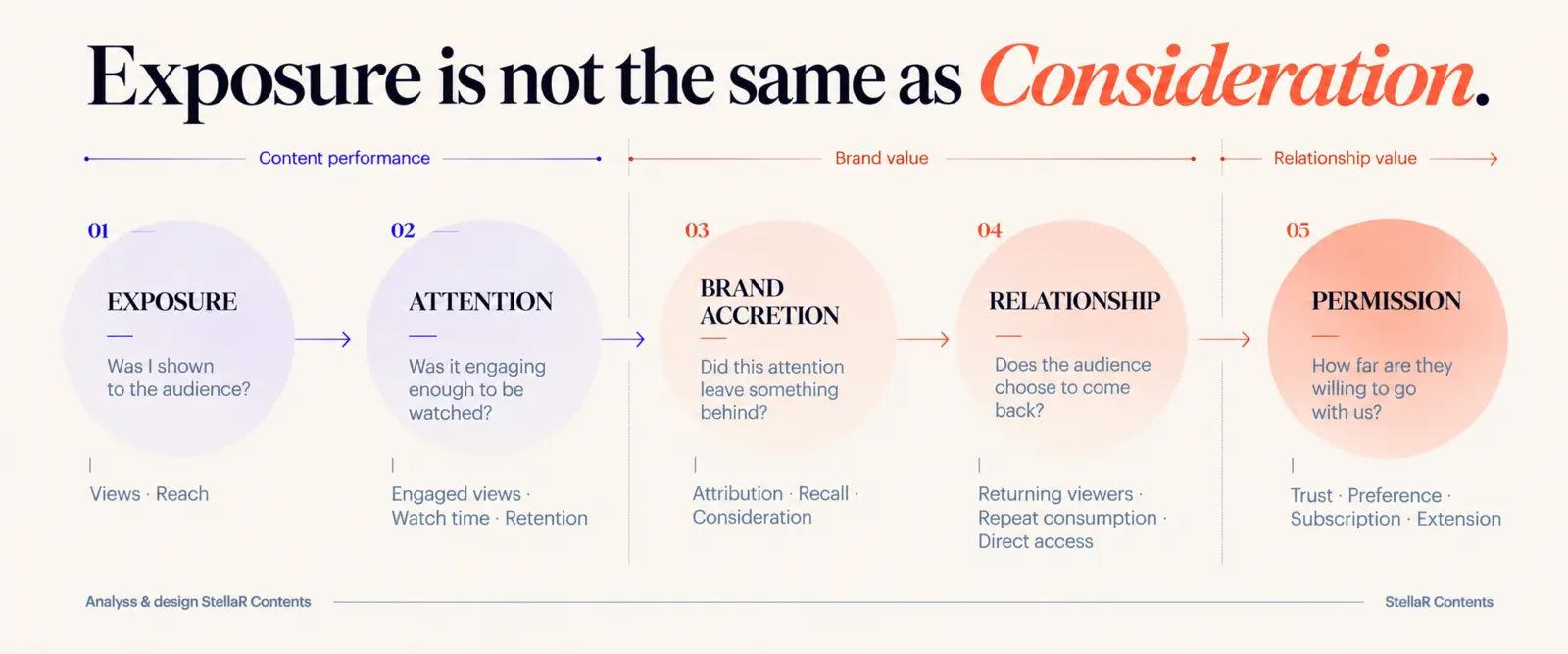
This is advertising research from a specific market; it cannot be directly translated into an editorial relationship. But it illustrates an important distinction: being exposed, being watched and changing someone’s perception represent different levels of connection.
That raises a more useful question than reach alone: how much of the attention earned remains attached to its source?
Consideration begins when the source matters. The audience may not yet have formed a habit, but something has changed: people recognize who is speaking, understand the value they bring and can imagine choosing them again.
The shift is from “I saw something interesting” to “I know why this source might interest me.” It sounds subtle. It is consequential.
An audience you encounter is not necessarily an audience that chooses you
This matters even more as discovery moves into environments where a publisher or brand controls less of the journey.
The Reuters Institute’s Digital News Report 2026 provides a useful measure. Among people consuming news videos on TikTok, 54% say they mostly encounter them while on the platform for another reason. The figure is 55% on Instagram.
On YouTube the pattern reverses: 55% say they mainly watch news videos intentionally, against 40% who encounter them incidentally.
The platforms and use cases are not identical. Still, the distinction is revealing. In one case, content finds the user. In the other, the user is more likely to seek out the content.
An encountered audience and a chosen audience can generate the same view count. They tell very different stories about the relationship. That is where a recurring appointment begins to matter.
A recurring appointment turns a promise into an experience
An editorial appointment is more than a publishing schedule. Posting every day does not necessarily create a habit; a monthly format can become so anticipated that its absence is noticed.
The foundation is a recognizable promise. What subject will we make clearer? From what perspective? For whom? With what degree of usefulness, depth or entertainment? The answer must be specific enough to create an expectation and open enough to endure.
A podcast, newsletter, YouTube show, recurring column or editorial franchise begins to work when it implicitly answers a simple question: “Why do I come back here?”
Each time the appointment delivers, that answer grows stronger. People no longer return only for a topic. They return because they know what kind of experience to expect. This may be the point at which an audience truly changes character: it is no longer only distributed. It is chosen.
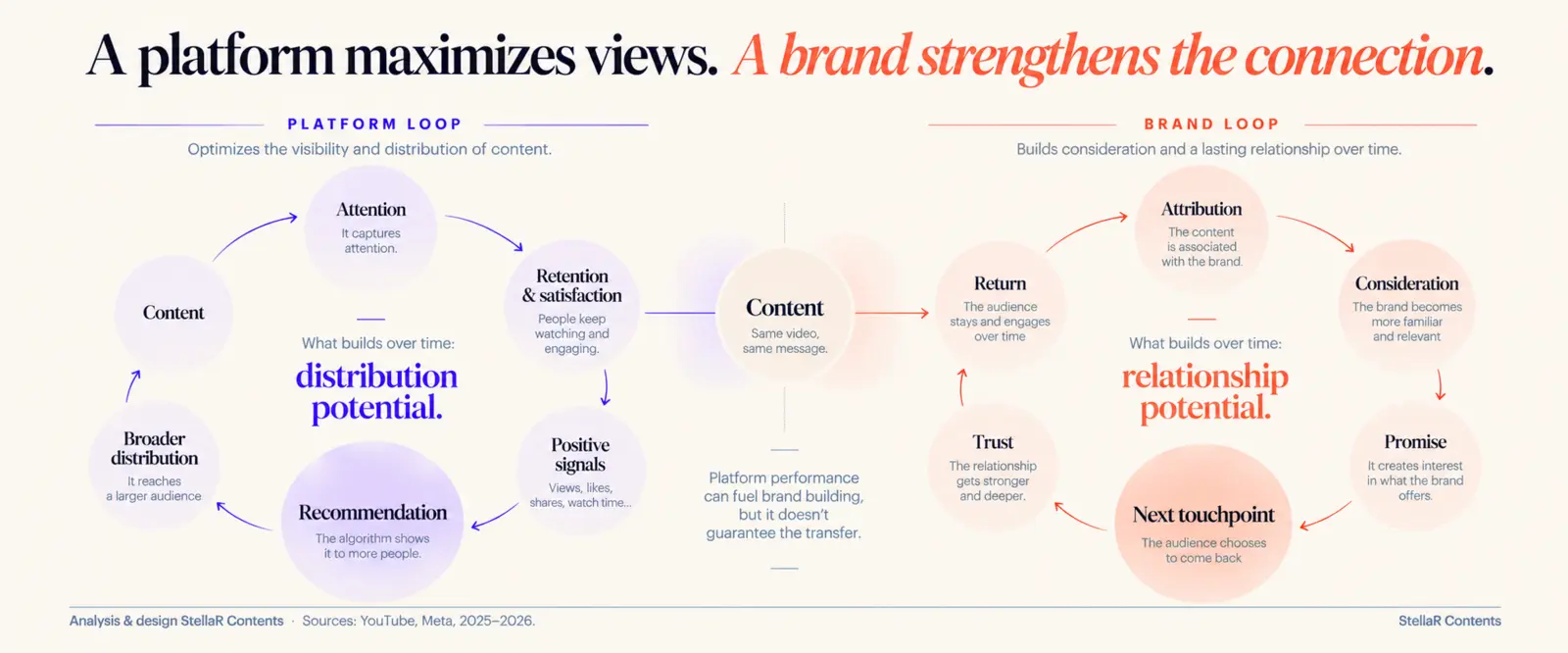
Two loops can then take hold
The first belongs primarily to the platform. Content earns attention. That attention produces signals. Those signals help estimate its appeal to other users, potentially widening distribution.
Attention → retention → positive signals → recommendation → reach → new attention.
The second belongs more to the brand. Content earns attention. Its source is recognized. A promise becomes clear. People return; the promise is fulfilled. Trust grows and makes another return more likely.
Attention → consideration → promise → appointment → trust → return → a stronger promise.
The two loops can reinforce one another. They can also diverge. A viral video may feed the first powerfully while doing almost nothing for the second. Conversely, a niche podcast, newsletter or channel may have far less reach while building a remarkably strong second loop.
Creators have built their edge around the appointment
Creators’ growth is worth examining through this lens. Their advantage is not only that they understand platform distribution. The strongest have built something harder to reproduce: a promise embodied by a person.
A voice, a point of view, a world, a way of telling stories and recognizable formats. People do not necessarily return because they know what the next topic will be. They return because they know how that topic will be told to them.
That is a meaningful difference. A traditional publisher may have a much better-known brand and a vastly larger editorial operation, yet offer fewer reasons to anticipate the next piece.
The relationship depends on more than the volume or intrinsic quality of content. It depends on how legible the promise linking that content together becomes.
The same holds for brands working with creators. The WPP Media/System1/TikTok research shows that outcomes do not simply track a creator’s audience size. Brand Fit, actual creator recognition and creative quality all influence the ability of content to build brand memory.
A large audience does not automatically equal a relationship, even when that audience already belongs to someone else.
Attention must be won again. Relationships can compound
Here the distinction becomes economic. With a passing audience, each new piece of content must almost start the contest again: it has to be distributed, selected, watched and interesting enough to earn another recommendation.
A relationship gradually changes that equation. The first time, someone needs persuading to watch. The second, they may recognize the format. By the fifth, they may know what it gives them. By the twentieth, they may choose it before they even know the exact topic, simply because they know its source.
The appointment progressively reduces the uncertainty before the next decision to pay attention. Attention has to be won again. A relationship can accumulate.
That is where an audience starts to become an asset.
A relationship does more than bring people back
Loyalty is often measured as an end in itself: repeat visits, active subscribers, frequency and retention. A trusted relationship creates something else. It gives you room to move.
In Edelman’s Brand Trust 2025 report, 88% of respondents across 15 markets say trust in a brand is important or a deal-breaker when choosing brands to buy or use, putting it on par with quality and value for money in that study.
For a publisher, brand or creator, that trust may take different forms. A newsletter can become a podcast. A podcast can become an event. Editorial expertise can turn into a course. A creator can launch a brand. A publisher can open a new vertical. A brand can evolve its editorial territory or launch a new offer.
Each time, the implicit question to the audience is the same: “You trusted us here. Will you follow us there?”
A relationship does not guarantee the answer. A promise can stretch so far that it loses coherence. A new offer can damage the very trust it was designed to build on. But a strong relationship creates an option that reach alone does not: permission to try.
Measure what remains, not only what passes by
None of this means giving up on reach. A brand that never meets new people will eventually exhaust its existing audience. But reach, attention, consideration and relationship should not be treated as the same thing.
A view answers a first question, now almost literally: were we shown? Retention asks another: was our content interesting enough for someone to stay? Attribution and consideration ask a third: did that attention build anything for our brand? An intentional return asks a fourth: did we give people a clear reason to come back? And trust raises the question that matters most: how far are they willing to follow us?
The shift changes what we measure. Engaged views tell us more than views alone. Retention curves show where attention falls away. Attribution tests whether attention stays with the brand. Returning viewers, repeat consumption, direct visits and deliberate search help show whether an appointment is forming. Subscriptions, adoption of a new format or conversion to a new offer can begin to reveal the latitude created by the relationship.
No single metric can do this on its own. Together, they help us see not only who passed by the content, but what the content left behind.
An audience is not (yet) a meaningful relationship
Platforms have made distribution more accessible. They have also become much better at identifying the content likely to hold our attention and showing it to others who may value it. That capability is powerful.
It can also create an illusion: that a piece of content accumulating reach must create equivalent value for the organization that made it. It does not always work that way.
A video can stick with the algorithm without its brand sticking with the audience. It can generate retention without creating an appointment. It can win distribution without yet building a relationship.
Attention creates the opportunity. Consideration gives a brand a place. An appointment gives people a reason to return. Repeatedly delivering on that promise gradually builds trust.
That trust is what changes the nature of the asset. It lets you reaffirm a promise and sometimes extend it: launch a new format, enter a new territory or propose an offer without having to rebuild all the interest that precedes it.
A platform measures whether a piece of content deserves to be shown again. A brand must measure whether it deserves to be chosen again.
That may be the most important distinction. An audience tells you how many people you reached. A relationship tells you how far they are willing to follow you.
Three questions for decision-makers
How much of our content performance actually builds something for our brand?
What recognizable promise gives our audience a reason to return by choice?
Which metrics distinguish the distribution we earn from the relationship we build?